
Compilation and Translation Review (CTR) is a semi-annual journal that was first published in September of 2008. As an academic journal in Taiwan that promotes both theoretical and practical research on the study and practice of translation and compilation, CTR publications include research papers, forums, book reviews, translation reviews and translation annotations.
The CTR Advisory and Editorial Board consist of renowned scholars from Asia, Europe and North America; this international breadth and depth further enhances the CTR’s academic prestige. The CTR has received the approval of the Research Institute for the Humanities and Social Sciences, Ministry of Science and Technology, and was incorporated into the database of the Taiwan Humanities Citation Index (THCI). The CTR adopts the policy of Creative Commons, meaning all previously-published articles can be downloaded for free.
Publication Frequency: Semi-annual (2 issues per year)
Honors: Taiwan Humanities Core Index (THCI), Scopus
Call for Papers Compilation and Translation Review National Academy for Educational Research
Compilation and Translation Review aims to publish research papers in the fields of translation and compilation studies. This journal is published twice a year, in March and September. We welcome submissions all year round and all submissions are reviewed upon receipt.
This journal accepts submissions written in traditional Chinese and English, the following types of submission are welcome:
Type
Description of Content
Theme
Suggested Length1
Research Paper
Original academic research on compilation and translation with clear and well-organized objectives, methods and conclusions.
Compilation and translation studies, compilation and translation theories, translation skills training, the translation industry, translation and culture, and other relevant areas of research (such as language education policy).
Chinese language manuscripts should not exceed 20,000 characters. English manuscripts should not exceed 12,000 words.
Commentary
Analysis, review and comparison of current research studies in order to enhance academic and practical research: e.g. comments on compilation, translation and language education policy; comments and feedback on teaching translation; the exchange of ideas and opinions about reviewing papers and editing; introduction of different branches of translation; the development of the translation and compilation industry; and discussion of the translation of academic terms.
3,000-5,000 characters
Book Review2
Introduction and criticism of new books
Important published works in translation studies
3,000-5,000 characters
Translation Review
Critical essays on translated works
Translated publications in professional fields
3,000-5,000 characters
Special Submission
Translation Annotation, Interview, Forum3, etc.
Topics mentioned above.
Chinese Manuscripts should not exceed 20,000 characters. English Manuscripts should not exceed 12,000 words.
1 The editorial board reserves the right to adjust the length if needed. The Chinese title is limited to 30 characters and the English title is limited to 12 words. The author should provide a running head (limit: Chinese 20 characters / English 50 characters).
2 Book Reviews will be invited by the editorial board.
3 Forum articles will be provided by the editorial board.
Chinese manuscripts should use traditional Chinese characters. Chinese translations of foreign places, book titles, or people’s names should be incorporated, and the original language should appear. When translating academic terms into Chinese, please consult the National Academy for Educational Research Web of Words (https://terms.naer.edu.tw). Please attach clear, high-resolution digital files for pictures and special signs.
Manuscripts that have already been published elsewhere are not allowed to be submitted. If the content will require the copyright of a third party, the author should get permission from the original owner according to the Copyright Act.
Manuscripts submitted must abide by the publication ethics of this journal. Anyone who violates academic ethics or submits same manuscript to different journals at the same time will be rejected and no more submissions will be accepted within one year. If the manuscript uses generative artificial intelligence technology (such as ChatGPT), the author should disclose the use of generative artificial intelligence technology in the manuscript and cite it in accordance with APA format (please refer to the publication format instructions).
Manuscripts should adhere to the latest APA format, and those which fail to do so will be returned for revision. Authors should keep one copy of their manuscripts. Manuscripts which meet the necessary requirements will be subjected to double-blind reviews. Those which pass the first and second reviews will be sent to the Editorial Board for a final decision. The Editorial Board reserves the right to edit manuscripts, so if the author is not willing to change the content of his/her article, prior notice should be given to the Editorial Board. Once the article is published, two copies of the issue in which it appears will be sent to the author.
Authors must submit the following documents along with their manuscripts:
3. Two copies of the original manuscript should include the following and be accompanied by the following documents, depending on the category of the submitted manuscript:
(1) Research paper:
(A)Title Page:
(a) Chinese and English titles
(b) Author’s name in Chinese and English
(c) Other relevant descriptions of the manuscript if needed.
(B) Chinese and English Abstracts (maximum word count for Chinese abstracts: 500 characters; for English abstracts: 300 words), Chinese and English keywords.
(C) Main Text
(D) References and Appendices
(2) Commentary
(A) Title Page:
(a) Chinese and English Title
(b) Author’s name in Chinese and English
(c) Other relevant information may be provided
(B) Main Text
(C) References and Appendices
(3) Translation review:
(A) Title Page:
(a) Chinese and English Title
(b) Author’s name in Chinese and English
(c) Title of the translated work and the original work
(d) Name of the translator and original author (editor)
(e) Publication information (location, publisher’s name, publication date)
(f) Total number of pages
(g) ISBN
(h) Book price
(i) Other descriptions of the book if needed
(B) Main Text
(C) References and Appendices
(4) Special submission:
(A) Title page:
(a) Chinese and English Title
(b) Author’s name in Chinese and English
(c) Other relevant information may be provided
(B) Main Text
(C) References and Appendices
4. Electronic files of the complete manuscript, pictures, and tables (attached to email)
Submission should be delivered to:
Compilation and Translation Review Editorial Board, National Academy for Educational Research
Compilation and Translation Review Review Guidelines
I. Review Process
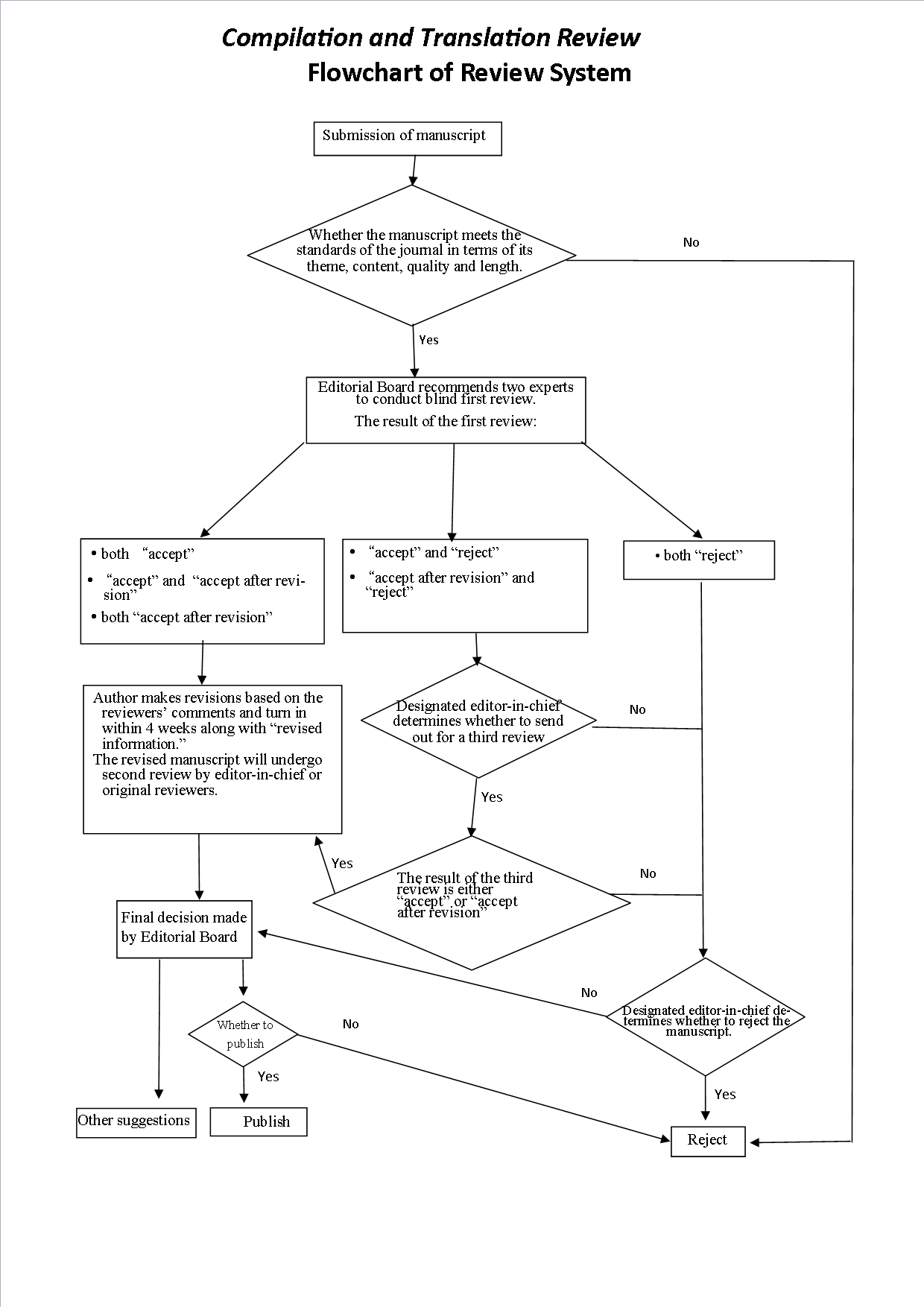
The review process includes initial screening, first review and second review.
1. Initial Screening
Each manuscript will first undergo initial screening for its theme, content and format to determine whether it will be rejected or sent out for review.
2. First Review
2.1 First review results have four categories:
Accept
Accept after revision
Review after revision (original reviewer reviews it again, the result of this review will be the reviewers’ first review result.)
Reject
2.2 When the results of the first two reviewers are as follows:
(1) Both say “accept”: Editorial Board will further discuss whether to accept the manuscript.
(2) They say “accept” and “accept after revision”, or both say “accept after revision”: Editorial Board will further discuss whether to accept the manuscript.
(3) They say “accept” and “reject,” or “accept after revision” and “reject”: The designated editor-in-chief will determine whether the manuscript should be sent to a third reviewer, based on the review comments and the total number of manuscripts submitted. When the manuscript is sent out for a third review, the reviewer will not be notified he/she is the third reviewer, so that the third reviewer can give an unbiased review of the manuscript.
(4) First two reviewers say “reject”: The manuscript will not be accepted.
3. Second Review
3.1 The author needs to turn in the revised manuscript along with “revised information” within four weeks. The second review will be conducted by the designated editor-in-chief or the original reviewers. Suggestions will be provided to the Editorial Board for a final decision.
3.2 Should the author be unable to turn in the revised manuscript within four weeks, he/she should notify the Editorial Board and get their consent in advance.
II. Review Guidelines
1. According to the topic of the manuscript, the Editorial Board will recommend two experts to conduct double-blind reviews and to avoid reviewers who may be acquainted with the author, such as by kinship, or as student-and-teacher, or as colleagues.
2. Review Criteria:
2.1 Originality, academic and/or practical value
2.2 Data acquisition, usage, and reference; adequacy of interpretation
2.3 Research methods and argument (evaluate according to the insights of the article)
2.4 Structure of the article, organization of argument, and English and/or Chinese fluency
3. Should members of the advisory board and/or editorial board intend to submit manuscripts, they should not be involved in the review process. The designated editor-in-chief also shall not submit a manuscript dealing with issues that he/she is in charge of.
4. Compilation and Translation Review adopts a double-blind review policy. All members of the Editorial Board will be responsible for keeping any information about the authors and reviewers confidential.
5. An author can submit more than one article for one issue. If two manuscripts by the same author pass the review, the Editorial Board reserves the right to determine the number of articles to be published, and in which issues of the journal they will be published. The author will also be informed of this.
III. Publication
1. Manuscripts that pass the first review will be submitted to the Editorial Board for a final decision. The Editorial Board will send “publication certification” to authors whose manuscripts have been accepted; the authors of articles that are rejected will also be notified.
2. The designated editor-in-chief may invite experts to submit articles on relevant issues, yet in this case the reviewing process shall still be subjected to the regular review guidelines.
3. First reviews for non-academic articles such as forums, book reviews, and translation reviews will be conducted by the designated editor-in-chief or review committee. After the first review, the Editorial Board will determine whether the manuscript can be published.
IV. Withdrawal of Manuscript
1. Authors may decide to withdraw their manuscripts either via email or in written form. Manuscripts shall be withdrawn upon confirmation by both parties.
2. For manuscripts that are undergoing the first review process, should the author decide to withdraw his/her manuscript, CTR will not accept any further submissions from the author for one year.
V. Rejection of Manuscript
To shorten the waiting time, authors whose manuscripts fail to pass the first review will be informed of this upon the consent of the designated editor-in-chief. Rejection of manuscripts will be reported to the Editorial Board for reference.
Compilation and Translation Review Publication Ethics
CTR (Compilation and Translation Review) aims to publish research papers which are original and have the potential for further development. All published articles will have undergone a strict review process. CTR does not accept articles that seem to have been subject to plagiarism, redundant submission, multiple submissions, fabricated data or an improper conflict of interest. The responsibilities of authors, reviewers, , editors and publishers are listed below:1
1. Duties of authors
Manuscript criteria: manuscripts shall follow the format and rules of the CTR. References and sources shall be indicated clearly. Violating academic ethics is strictly prohibited.
Data usage and completeness: the source of the data should be clearly stated in the manuscript and all original research data should be kept.
Originality and plagiarism: originality of papers shall be greatly emphasized; any plagiarism, unclear references or unclear use of data will not be allowed.
Single submission of manuscripts: research papers shall not be submitted if their content is similar to that of another paper (or papers) already submitted.
Clear citations and references: citations and references must be very clear when others’ works are being referred to.
Clear lists of authors: anyone who made contributions to the manuscript, whether by helping to plan the study or by helping to write the article, shall be deemed co-authors. Corresponding authors shall ensure that all co-authors have agreed to submit the article, and have thoroughly checked it before submission.
Protecting research participants: should the research involve human participants, details shall be clearly recorded in the article and relevant rules shall be adhered to.
Transparency and conflicts of interest: authors shall disclose any information regarding financial support, patent applications, remuneration, or any other area where there might be a conflict of interests that could affect the research results and the interpretation of these results.
Data correctness: should a manuscript contain incorrect data, the author shall inform the editors and provide correct data as soon as possible.
If the author uses generative AI technologies in the writing process, the author should disclose the use of generative AI technologies in the manuscript, and cite sources in accordance with APA format. The author has ultimate responsibility and liability for the content of the work.
2. Duties of reviewers
Professional feedback: Reviewers shall provide professional feedback in order to assist in deciding whether manuscripts meet the publication criteria.
Efficiency: Reviewers shall complete their work promptly.
Confidentiality: It is not allowed to reveal relevant information about manuscripts to other institutions or people other than the editors.
Objectivity: The reviewing work shall be carried out fairly and objectively. Constructive comments on the manuscripts shall be provided.
Sources of data: Extra attention shall be paid to whether the author has made clear reference to relevant previous research. If the manuscript bears more than a little similarity to other (or previous) research, reviewers shall be responsible for reminding the editors of this point.
Transparency and conflicts of interest: It is prohibited for reviewers to use unpublished data they find in an article for their own advantage, without gaining prior consent from the author. Should a conflict of interests arise between reviewers and authors or institutions, the reviewers are not qualified to do their job.
3. Duties of editors
Double blind peer review: CTR adopts a double blind peer review policy. Editors shall keep the reviewers’ and authors’ information confidential and abide by review guidelines.
Final decision to publish: Based on the review results, editors reserve the right to determine whether a manuscript meets the publication criteria.
Impartiality: Reviews shall be conducted fairly and objectively using clear and consistent criteria.
Confidentiality: During the review process, members of the Editorial Board shall not reveal the identity of reviewers or any other relevant information to authors. It is also not allowed to reveal information about the authors to reviewers.
Transparency and conflicts of interest:
1) Editors shall not use unpublished data they find in submitted articles for any purpose without the prior consent of authors.
2) The reviewers' suggestions should not be diverted to private use.
3) Should a conflict of interests arise between an editor and an author, or an editor and an institution, the editor should avoid any editorial discussion.
Investigation cooperation: Should a case of violation of publication ethics occur, editors shall cooperate to the fullest extent possible in any investigation.
4. Duties of publishers
Publishers must ensure that any advertising or other business-related media will not affect editorial decisions.
Publishers shall follow the guidelines of COPE (Committee on Publication Ethics) to ensure that there is no violation of publication ethics or other forms of misconduct.
1. CTR Publication Ethics are regulated based on Elsevier (https://www. elsevier.com/editors/publishing-ethics), (https://www.elsevier.com/about/policies-and-standards/publishing-ethics#0-publishing-ethic) and COPE (https://publicationethics.org/).